
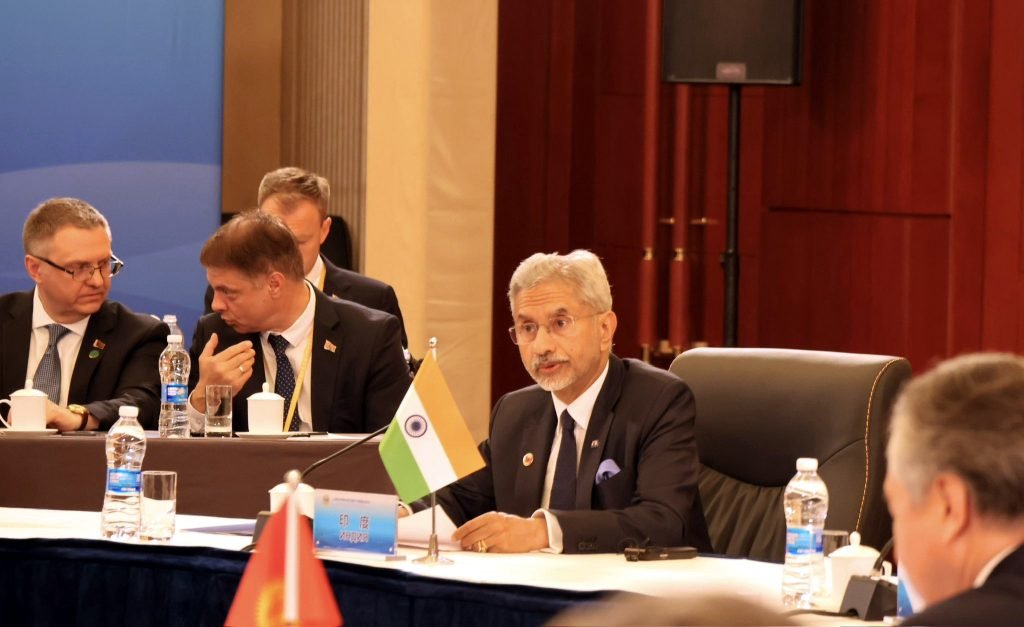
Tianjin (China), Jul 15: External Affairs Minister S Jaishankar on Tuesday called on the Shanghai Cooperation Organisation (SCO) to stay true to its founding objective of fighting terrorism, separatism and extremism, and adopt an “uncompromising” stance on these threats. His remarks came as he strongly defended India’s response to the recent Pahalgam terror attack, which he said aimed to undermine Jammu and Kashmir’s tourism economy and sow communal discord.
Addressing the SCO foreign ministers’ meeting in Tianjin, Jaishankar, speaking before his counterparts from China, Pakistan and other member states, said: “The three evils that SCO was founded to combat were terrorism, separatism and extremism. Not surprisingly, they often occur together. Recently, we in India witnessed a graphic example in the terrorist attack in Pahalgam on April 22.”
He noted that the UN Security Council had condemned the attack and called for holding the perpetrators, organisers, financiers and sponsors accountable. “We have since done exactly that and will continue doing so,” he asserted.
The minister’s call for an uncompromising approach comes amid concerns in New Delhi over China’s perceived support to Pakistan during Operation Sindoor, as well as Beijing’s past moves to block sanctions on Pakistan-based terrorists at the UN Security Council.
While reaffirming India’s commitment to work constructively within the SCO, Jaishankar emphasised that cooperation must be grounded in “mutual respect, sovereign equality and in accordance with territorial integrity and sovereignty of member states” — an indirect reference to the contentious Belt and Road Initiative (BRI) which India opposes for infringing on its sovereignty.
“The SCO’s ability to contribute to shaping world affairs will naturally depend on how well it comes together on a shared agenda,” he said, adding: “That means taking everybody on board.”
Jaishankar also addressed broader geopolitical challenges, warning of rising conflicts, competition and coercion, as well as economic instability. “The challenge before us is to stabilise the global order, de-risk various dimensions and, through it all, address longstanding challenges that threaten our collective interests,” he said.
Highlighting India’s contributions to the SCO — including initiatives in start-ups, innovation, traditional medicine and digital public infrastructure — Jaishankar reiterated that India would “positively approach” new proposals for collective benefit.
He urged the grouping to enhance development assistance to Afghanistan, citing longstanding humanitarian concerns and the need for regional stability. “India, for its part, will certainly do so,” he said.
On trade and connectivity, Jaishankar underlined the importance of improving transit facilities among SCO states. “One of them is the lack of assured transit within the SCO space. Its absence undermines the seriousness of advocating cooperation in economic areas,” he noted, adding that India continues to promote the International North-South Transport Corridor (INSTC) to boost regional trade links.
Concluding, Jaishankar said that as the world moves towards greater multipolarity, effective groupings like the SCO have an important role — provided they remain unified and faithful to their founding principles.

Recent Comments