
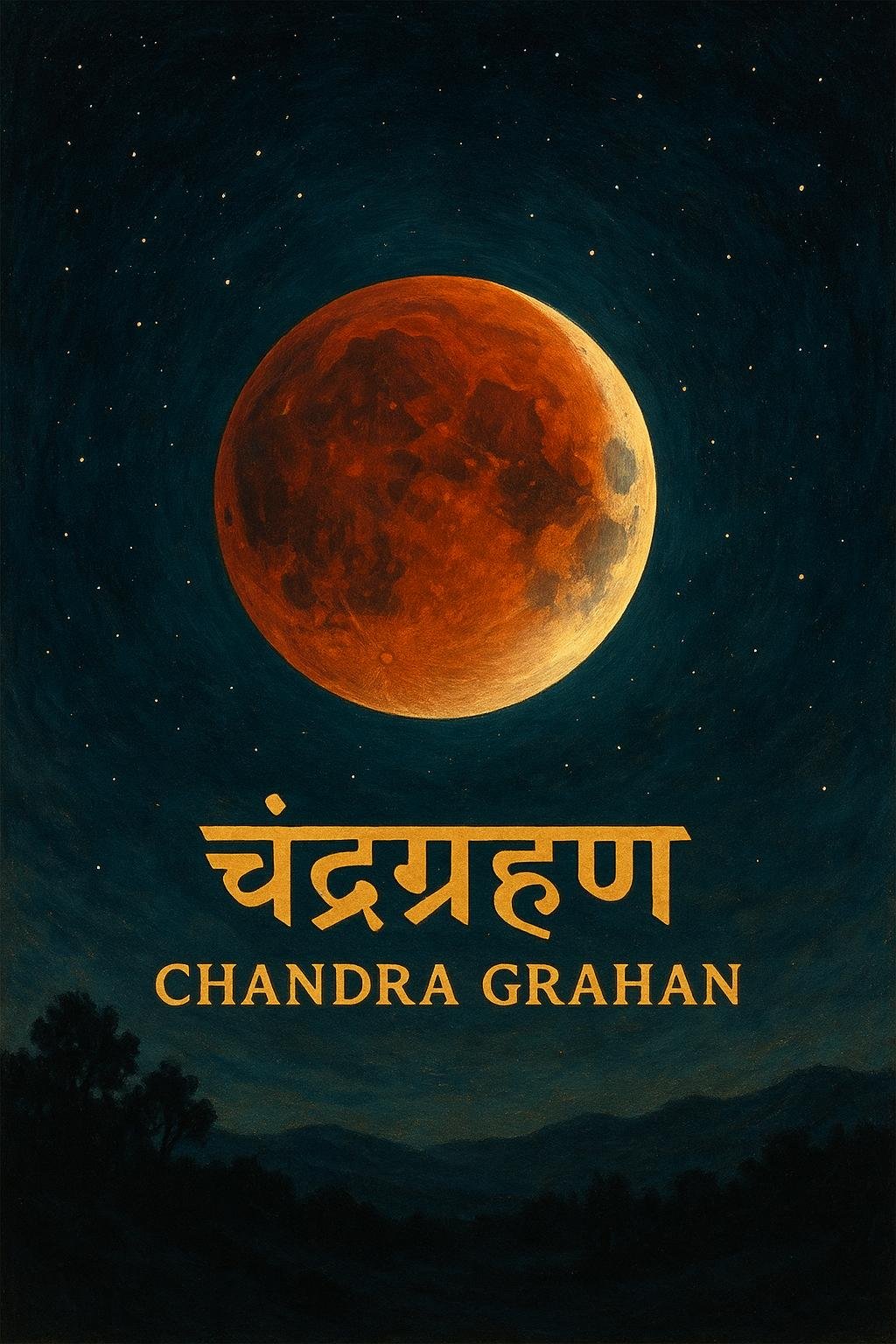
Chandra Grahan 2025: India to Witness Rare 82-Minute Total Lunar Eclipse on September 7–8
New Delhi, Sep 7: Skywatchers across India are in for a celestial spectacle as the year’s second and final lunar eclipse (Chandra Grahan) will unfold on the night of September 7–8, 2025. The event will be visible in its entirety from most parts of India, making it a rare treat for astronomy enthusiasts and the general public alike.
When Will the Lunar Eclipse Happen?
According to the India Meteorological Department (IMD) and global astronomy trackers, the eclipse will begin with the penumbral phase at 8:58 PM (IST) on September 7. The much-awaited total eclipse, or “Blood Moon” phase, will occur between 11:00 PM and 12:22 AM, lasting for an impressive 82 minutes. The celestial event will finally end at 2:25 AM on September 8.
This extended totality makes it one of the longest lunar eclipses of recent times, giving observers ample time to witness the phenomenon.
What Will It Look Like?
During the total eclipse, the Moon will turn a deep reddish-orange—a sight popularly known as the “Blood Moon.” This happens because sunlight bends through the Earth’s atmosphere, scattering shorter blue wavelengths and allowing only red light to reach the lunar surface.
Astronomers highlight that the brightness and colour of the Moon will depend on atmospheric conditions, including the presence of dust, clouds, or volcanic ash.
Where Will It Be Visible?
The September 2025 lunar eclipse will be visible across:
- India – full visibility across all regions
- Asia, Africa, Europe, Australia – full or partial visibility
- Parts of the Middle East and South America
In India, cities from Delhi, Mumbai, Bengaluru, Chennai, Srinagar, and Kolkata will all get a clear view, weather permitting.
Cultural and Religious Significance
The Chandra Grahan coincides with Pitru Paksha and Purnima Shraddha, considered an important period in the Hindu calendar. Traditionally, the Sutak Kaal—a time of spiritual observance—begins nearly 9 hours before the eclipse and ends only after it concludes. Many temples remain closed during this period, and devotees follow rituals such as avoiding cooking and eating until the grahan ends.
For instance, in Jammu & Kashmir, the Sutak Kaal will be observed from 12:28 PM on September 7 until 1:26 AM on September 8.
Tips for Safe Viewing
- Unlike solar eclipses, lunar eclipses are safe to watch with the naked eye—no special glasses are required.
- Binoculars and telescopes can enhance the experience, especially during the blood moon phase.
- Photography enthusiasts are advised to use tripods for capturing clear images of the red-hued moon.
Why Is It Special?
This will be the second and final lunar eclipse of 2025, and with an unusually long 82-minute totality, it is expected to be a once-in-years opportunity. The next total lunar eclipse visible in India will not occur until 2026, making this event particularly significant for skywatchers.
✨ In Summary:
- Date: September 7–8, 2025
- Total Eclipse Duration: 82 minutes (11:00 PM – 12:22 AM)
- Visibility: Across India and several continents
- Phenomenon: Moon turns red, popularly called “Blood Moon”

Recent Comments