
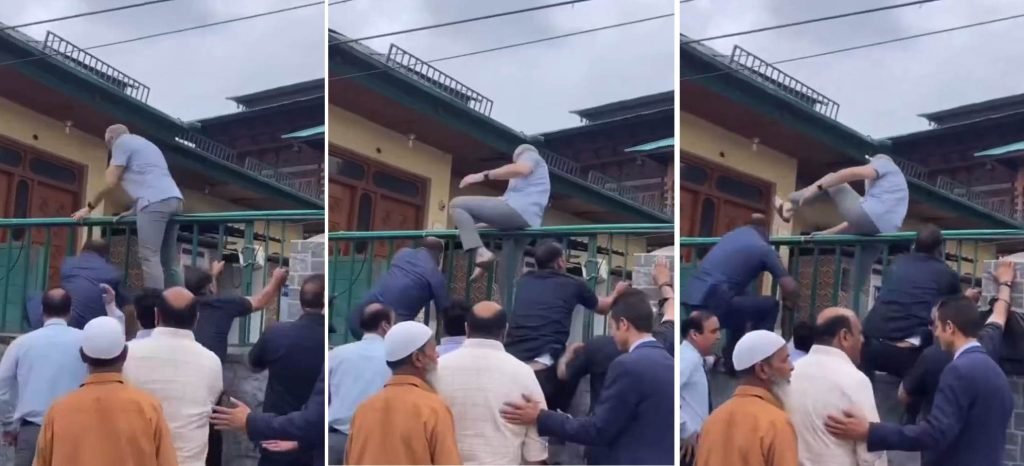
SRINAGAR, Jul 14: In a dramatic display of defiance, Jammu and Kashmir Chief Minister Omar Abdullah on Monday climbed the locked gates of the Naqshband Sahib graveyard in Srinagar to pay tribute to the 22 people killed by the Dogra army in 1931, accusing security forces and the administration of trying to block his way “through physical grappling.”
The confrontation unfolded a day after Omar Abdullah and several National Conference and opposition leaders were allegedly put under house arrest to stop them from marking Martyrs’ Day on July 13 — a day commemorated annually in Jammu and Kashmir to remember those who fell resisting the autocratic Dogra rule.
As roads leading to the graveyard from Khanyar and Nowhatta remained sealed by security forces, Abdullah’s convoy halted near Khanyar. Undeterred, the chief minister walked more than a kilometre, only to find the graveyard gates locked. He then scaled the gate and entered the premises to offer ‘fateha,’ joined by his security team and fellow party leaders, before the gates were eventually opened.
National Conference president Farooq Abdullah also reached the memorial by hiring an autorickshaw, while Education Minister Sakina Ittoo arrived riding pillion on a scooty, evading restrictions imposed by the authorities.
Speaking to reporters after the incident, a visibly agitated Omar Abdullah lashed out at Lt Governor Manoj Sinha and the police: “It is sad that on the instructions of people who claim their responsibility is to ensure security and law and order, we were stopped from offering ‘fateha.’ They kept us under house arrest yesterday, and today too they tried to stop us and even manhandle us.”
“This is a free country,” he said, adding, “But they think of us as their slaves. We are not. We are servants of the people. I don’t understand why they destroy the law while in uniform.”
Videos shared by Abdullah on X (formerly Twitter) showed uniformed personnel trying to physically restrain him and his team. “This is the physical grappling I was subjected to but I am made of sterner stuff & was not to be stopped,” he wrote, questioning under what law the police were trying to prevent them from offering prayers.
Defending his act of scaling the graveyard gate, Abdullah argued that the martyrs’ graves remain there all year and cannot be remembered only on a designated day: “How long can the LG administration stop us? If not on July 13, it could be July 12, 14, or even December, January, or February. We will come here whenever we feel like,” he asserted.
Since 2020, the Union Territory administration has removed Martyrs’ Day from the list of gazetted holidays — a move that has drawn criticism from regional parties, who see it as part of an attempt to erase Kashmir’s political history.

Recent Comments