
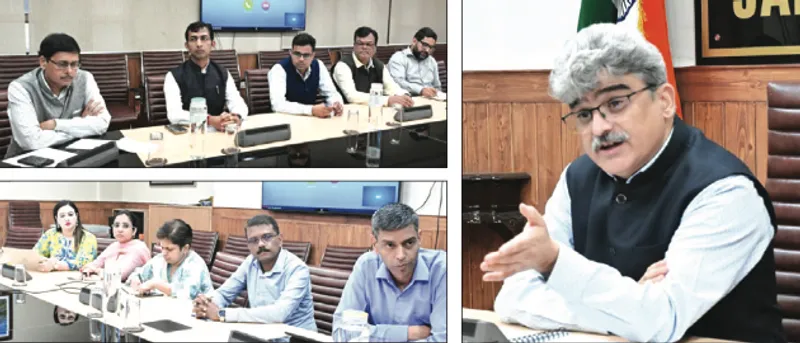
Anantnag/Kulgam/Shopian, Sep 8 — A seven-member Inter-Ministerial Central Team (IMCT) deputed by the Ministry of Home Affairs visited the flood-affected districts of Anantnag, Kulgam, and Shopian in South Kashmir to assess the damage caused by recent heavy rainfall, flash floods, and landslides.
In Anantnag, the team met with district officials to review the relief and rehabilitation efforts. Authorities briefed the IMCT on evacuation operations, restoration of basic services, and provision of temporary shelters. The team also assessed public infrastructure damage and discussed long-term disaster resilience and flood mitigation plans.
The IMCT conducted on-ground inspections of embankments, roads, streams, and damaged public utilities in affected areas. Officials emphasized that the Centre would provide both financial and logistical support to aid recovery in the region.
In Kulgam, the team held a detailed review with the district administration and representatives from key departments. A thorough assessment of the damage from floods, cloudbursts, and landslides was presented. Restoration of drinking water, electricity, and road connectivity were highlighted as major priorities.
The IMCT also visited flood-hit villages like Khudwani and Qaimoo, interacting with residents to understand their challenges and demands. The team assured that the feedback from the ground would be included in the final report to the Centre for immediate relief measures and future planning.
In Shopian, the team reviewed damages to roads, power infrastructure, and residential areas. Though the district is less flood-prone than others, it still suffered significant losses, particularly in the Zainapora subdivision, where low-lying villages were inundated.
The district administration informed the team that key power lines, transformers, and drinking water schemes have largely been restored. Around 25 roads were damaged, with 24 already repaired. Efforts are ongoing to keep the Mughal Road operational despite landslide-induced damage at the 24th km.
Around 28 villages covering 4,284 hectares and a population of over 17,000 were affected. The district evacuated 129 families and set up 21 temporary shelters, rescuing over 600 people. Restoration of damaged houses and assessment of crop losses are underway.
Protective works such as embankments and crate bunds have been initiated in flood-prone areas like Hydergund, Zainapora, and Safanagri, as part of a long-term resilience strategy.
Meanwhile, Chief Secretary Atal Dulloo held a meeting with the IMCT to push for immediate central assistance. He called for the urgent restoration of critical infrastructure like roads, bridges, power lines, water supply, and schools across affected districts.
He also advocated for a comprehensive safety audit of all key public infrastructure to ensure structural resilience, especially in disaster-prone areas.
Special relief was sought for farmers who suffered crop and land losses. The Chief Secretary urged the Centre to cover the premium share under PMFBY, so farmers can avail insurance benefits without financial burden.
Connectivity remains a major concern, and Dulloo stressed the need for central road agencies to expedite the restoration of damaged roads and improve links in cut-off areas.
In the Jammu division, the Chief Secretary received updates from the Divisional Commissioner and various district heads about the ongoing relief and rehabilitation work. Officials reported steady progress in restoring essential services like electricity, water supply, and local connectivity.
The visit comes as Jammu and Kashmir continues to recover from weeks of adverse weather that has claimed nearly 150 lives and caused major disruptions across key roadways, including the Jammu-Srinagar National Highway.

Recent Comments