
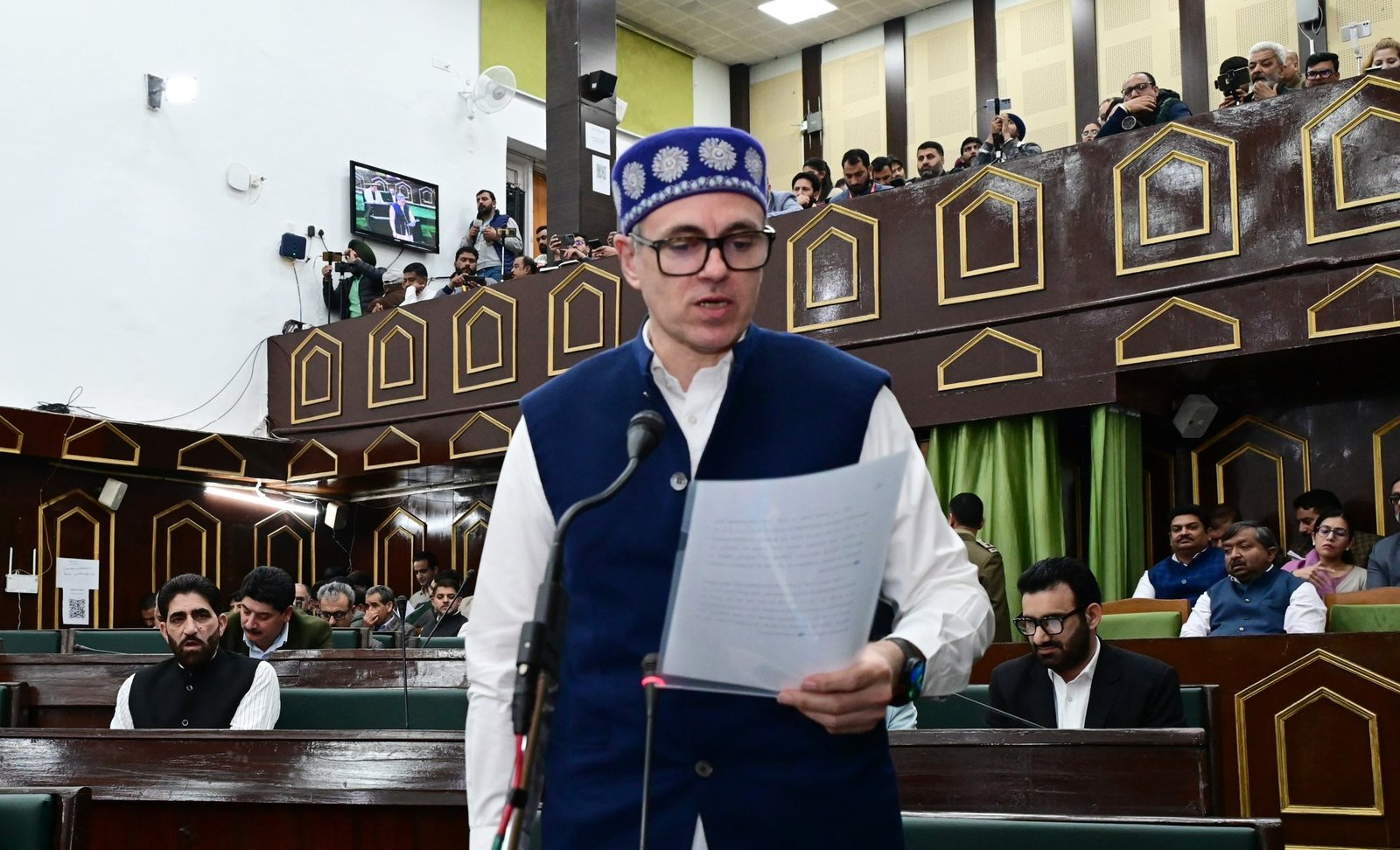
Jammu, Feb 18: Jammu and Kashmir’s total debt for the financial year 2024–25 is estimated at ₹1,37,067 crore, accounting for 48 per cent of the Union Territory’s Gross State Domestic Product (GSDP), which has expanded to ₹2,88,422 crore, Chief Minister Omar Abdullah informed the Legislative Assembly on Wednesday.
Defending his government’s fiscal management strategy in a written reply to the House, the Chief Minister said the growth in GSDP has helped reduce the debt-to-GSDP ratio from 51 per cent in 2023–24 to 48 per cent in the current fiscal.
Detailing the debt trend over the past six years, Abdullah said that in 2019–20, total liabilities stood at ₹89,037 crore, constituting 54 per cent of the GSDP of ₹1,64,103 crore.
In 2020–21, liabilities increased to ₹98,244 crore, with the debt-to-GSDP ratio rising to 59 per cent, largely due to the economic contraction during the COVID-19 pandemic.
In 2021–22, liabilities rose further to ₹1,06,753 crore, but the ratio declined to 53 per cent as economic recovery gathered pace. In 2022–23, liabilities stood at ₹1,09,825 crore, and the ratio further declined to 48 per cent.
“In 2023–24, liabilities increased to ₹1,25,205 crore, with the ratio at 51 per cent,” Abdullah said, adding that in 2024–25, liabilities are projected at ₹1,37,067 crore while GSDP has significantly expanded, bringing the ratio back to 48 per cent.
The Chief Minister emphasised that fiscal sustainability has improved over the years, with economic growth moderating the impact of rising debt on the Union Territory’s finances.
He asserted that borrowings have not been directed towards unproductive expenditure. “A substantial portion of funds has been channelled into capital expenditure, infrastructure development, power sector reforms and asset creation, strengthening long-term growth potential,” he said.
Capital outlays during the period under review consistently supported investments in roads, power infrastructure, healthcare facilities and other productive sectors, he added.
Abdullah further maintained that borrowings were kept within the prescribed limits under the Fiscal Responsibility and Budget Management (FRBM) framework, with emphasis on calibrated market borrowings, improved cash management and prioritisation of development-linked spending.
“The concern that rising internal debt has occurred without commensurate creation of productive assets is not established by the data. The improving debt-to-GSDP ratio and sustained capital investment clearly indicate responsible fiscal management,” the Chief Minister said.

Recent Comments