
Targets self-reliance in pulses by 2030; urges farmers to increase exports and reduce imports
NEW DELHI, Oct 11: Prime Minister Narendra Modi on Saturday unveiled two flagship agricultural initiatives worth ₹35,440 crore aimed at strengthening India’s farm sector, enhancing pulses production, and accelerating growth in 100 low-performing districts. The Prime Minister launched the ‘Pradhan Mantri Dhan Dhaanya Krishi Yojana (PM-DDKY)’ with an outlay of ₹24,000 crore, and the ‘Mission for Aatmanirbharta in Pulses’ worth ₹11,440 crore, during a special event held at the Indian Agricultural Research Institute (IARI), Pusa in New Delhi.
The schemes, already approved by the Union Cabinet, will be implemented from the upcoming rabi season and continue till 2030–31. They are expected to bring transformative changes in the agricultural landscape, especially in districts that lag behind in productivity and infrastructure.
In his address, the Prime Minister urged farmers to focus on diversification beyond wheat and rice, stressing the need for self-reliance in pulses to ensure protein security and reduce import dependence.
“Despite being the world’s largest producer and consumer of pulses, India still imports a significant quantity. Our aim is to change that. Under the pulses mission, we will increase pulses acreage by 35 lakh hectares and raise production from 252.38 lakh tonnes to 350 lakh tonnes by 2030–31,” Modi said.
Under the PM-DDKY, the government aims to boost productivity in 100 low-performing agricultural districts by integrating 36 schemes from different ministries. The programme will focus on crop diversification, irrigation improvement, storage and processing facilities, and credit accessibility for farmers. It is modelled on the Aspirational Districts Programme (ADP), which has yielded visible improvements in several social sectors.
Modi emphasized that the scheme’s success will depend on coordination between local administrations and farmers. “Just as the Aspirational Districts Programme succeeded through the commitment of District Magistrates and Collectors, this scheme too will rely on district-level leadership to tailor plans as per local needs,” he added.
The Prime Minister also inaugurated agricultural projects worth ₹5,450 crore and laid the foundation stones for projects of around ₹815 crore, covering agriculture, animal husbandry, fisheries, and food processing sectors.
Taking a dig at previous Congress governments, Modi accused them of neglecting the farm sector and lacking “vision and strategy” for its growth. “There was no roadmap, no coordination between departments. The entire system was weakening. After 2014, we changed this careless approach and began reforming agriculture — from seeds to markets,” he said.
Highlighting his government’s initiatives, Modi said the agriculture budget has increased six-fold in the last decade. He noted that the government provided ₹13 lakh crore in fertiliser subsidies over 10 years, with ₹3.75 lakh crore transferred directly to farmers under the PM-Kisan scheme, compared to ₹5 lakh crore spent on subsidies during the UPA era.
He also pointed out that GST reductions on agricultural machinery and equipment have benefited farmers by reducing both equipment and household costs. As a result, agricultural exports have nearly doubled in 11 years, while foodgrain production has risen by 90 million tonnes and fruit and vegetable output by 64 million tonnes.
Under the Pradhan Mantri Fasal Bima Yojana, the government has disbursed insurance claims worth ₹2 lakh crore to farmers, and more than 10,000 Farmer Producer Organisations (FPOs) have been established to strengthen market access and collective bargaining.
“Farmers are the foundation of a Viksit Bharat (Developed India). You made the country self-reliant in food grains after Independence; now you have a bigger role in making India a developed nation by 2047,” Modi said, calling on farmers to “knock on the doors of the global market.”
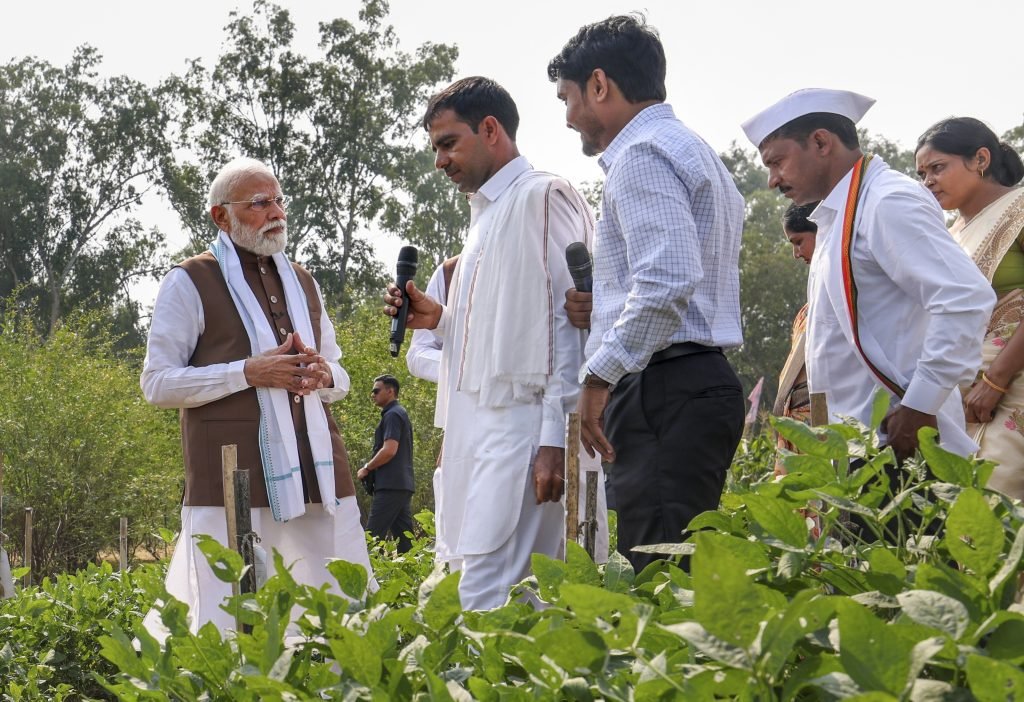
Union Agriculture Minister Shivraj Singh Chouhan and Fisheries, Animal Husbandry and Dairying Minister Rajiv Ranjan Singh were present at the event. The Prime Minister also interacted with farmers who shared their experiences of adopting government-backed innovations in pulses cultivation and integrated farming practices.
With these new schemes, the government aims to lay a strong foundation for an inclusive, technology-driven, and self-reliant agricultural ecosystem, ensuring both economic and nutritional security for the nation.

Recent Comments