
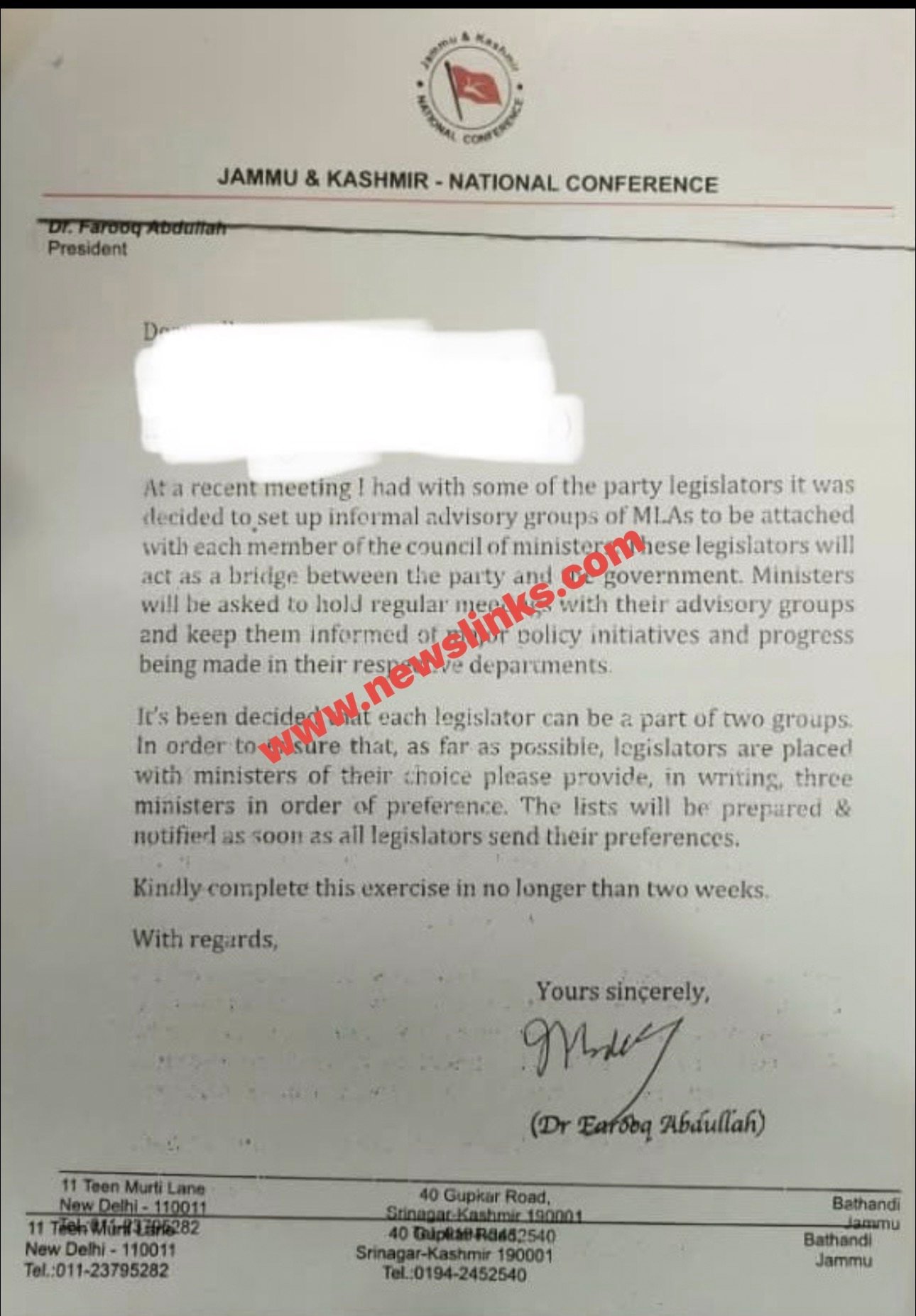
Srinagar: Amid growing internal tensions and reported discontent within the National Conference (NC), party president Dr Farooq Abdullah has initiated a fresh move to address concerns among party legislators by proposing the formation of informal advisory groups of MLAs to be attached to members of the Council of Ministers.
The development comes against the backdrop of growing differences within the ruling party following the recent cabinet expansion, when more than 20 party MLAs reportedly raised their voices against the expansion and expressed dissatisfaction over the manner in which the government was reconstituted. The resentment among a section of legislators had brought internal differences within the National Conference into focus, prompting demands for greater consultation and participation in the functioning of the government.
In a significant move to address these concerns, Farooq Abdullah has now written to party legislators, asking them to submit their preferences for being associated with ministers through informal advisory groups.
According to the communication, the decision to constitute these groups was taken during a recent meeting with some party legislators. The proposed arrangement is aimed at strengthening coordination between the party organisation and the government headed by Chief Minister Omar Abdullah.
The advisory groups are expected to act as a bridge between the party and the government, providing legislators with a platform to remain connected with departmental functioning, policy decisions and development initiatives.
Under the proposed arrangement, every member of the Council of Ministers will have an informal advisory group of MLAs attached to them. Ministers will be asked to hold regular meetings with their respective groups and keep legislators informed about major policy initiatives, important decisions and the progress of work being undertaken in their departments.
Farooq Abdullah has clarified that each legislator can become a member of two advisory groups. To facilitate the formation of these groups, all party MLAs have been asked to submit, in writing, the names of three ministers in order of preference so that, as far as possible, legislators can be associated with ministers of their choice.
The lists of advisory groups will subsequently be prepared and formally notified after all legislators submit their preferences. The party president has asked the MLAs to complete the exercise within a maximum period of two weeks.
The latest initiative assumes significance as some disgruntled legislators had earlier submitted a memorandum to the party leadership, suggesting the constitution of consultative committees comprising MLAs to be attached to ministers. The demand was aimed at ensuring greater involvement of elected representatives in governance and establishing a more effective mechanism for communication between ministers and party legislators.
The proposed advisory groups appear to address one of the key demands raised by the dissatisfied MLAs, although it remains to be seen whether the arrangement will satisfy the concerns of legislators who had expressed resentment following the cabinet expansion.
With the National Conference leading the government in Jammu and Kashmir, the latest move also highlights the party leadership’s effort to strengthen internal coordination and ensure that elected representatives have a more direct role in monitoring departmental functioning and communicating public concerns to the government.
Whether this new mechanism will help ease the differences within the party and restore confidence among the legislators will become clearer once the advisory groups are constituted and begin functioning.

Recent Comments