
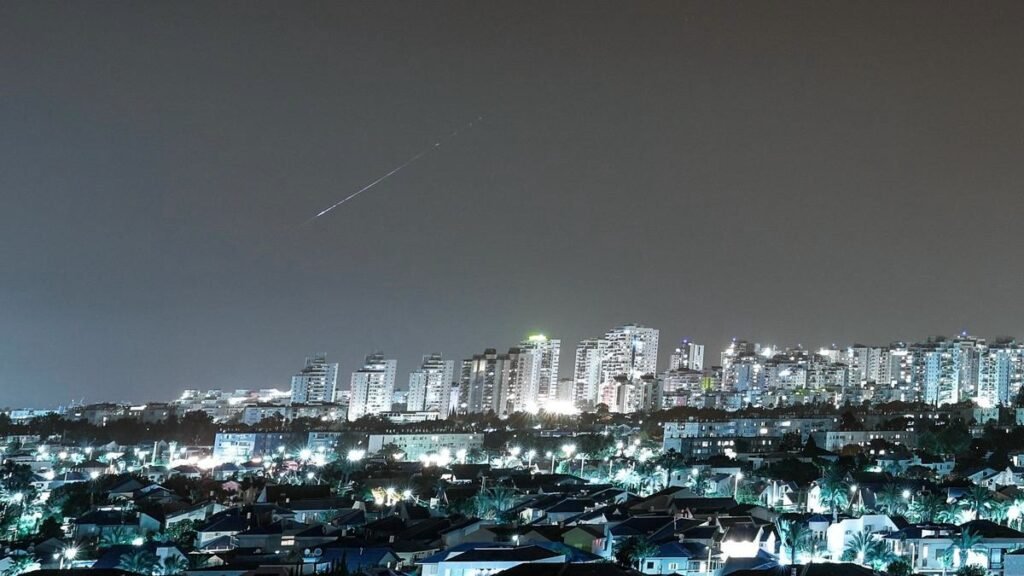
Jerusalem, Jun 8: Tensions in West Asia escalated sharply on Sunday after Iran launched missiles at Israel, marking the first direct attack since a fragile ceasefire came into effect in early April and raising fears of a return to full-scale hostilities across the region.
Iran’s state broadcaster confirmed the missile launches, while authorities in Tehran shut down western airspace in anticipation of a possible Israeli response. The attack came hours after Israel struck Beirut’s southern suburbs, despite reported efforts by the United States to prevent further escalation.
Air raid sirens sounded across several parts of Israel, sending millions of residents scrambling to shelters. The Israeli military said it successfully intercepted the missiles, and no immediate casualties were reported. Explosions were heard in northern Israel before authorities announced that residents could leave protected areas.
Iran’s Revolutionary Guard warned that any repetition of what it termed “acts of aggression” would trigger a broader response targeting American and Israeli interests across the region. The statement referred to recent developments in Lebanon and attacks involving Iranian vessels near the Strait of Hormuz.
“Iran has made a grave mistake,” Israeli military spokesperson Brig. Gen. Effie Defrin said, while Chief of Staff Lt. Gen. Eyal Zamir warned that Israel was prepared to strike back “with determination” if ordered.
However, signs emerged that Washington was working to prevent a wider conflict. According to a senior US official, President Donald Trump spoke with Israeli Prime Minister Benjamin Netanyahu and urged him not to retaliate immediately. The official said Trump had persuaded Netanyahu to hold off on a response “for the time being.”
Trump later indicated that Israel did not require further military action, telling media outlets that he wanted Iran to cease missile attacks and return to negotiations. He also expressed dissatisfaction with Israel’s earlier strike on Beirut, saying it had not been coordinated with Washington.
The latest escalation follows Israel’s attack on a residential building in Beirut’s southern suburbs, which Lebanon’s health ministry said killed two people and injured 20 others. The strike came despite recent US-hosted ceasefire talks involving Lebanon and Israel, which had sought to prevent further cross-border violence.
Hezbollah claimed responsibility for firing rockets towards northern Israel earlier in the day, while Israel vowed to continue military operations across Lebanon. The ongoing confrontation has complicated broader diplomatic efforts to secure a comprehensive ceasefire in the region.
Iran has repeatedly insisted that any long-term agreement with the United States must include an end to hostilities in Lebanon. Meanwhile, Hezbollah opposes direct negotiations between Lebanon and Israel and supports Tehran’s position linking the Lebanese front to wider regional talks.
The missile exchange also disrupted regional air traffic. Iraq closed its airspace for 72 hours, Syria announced a 12-hour closure, and all flights from Tehran’s main international airport were suspended, according to Iranian authorities.
The renewed tensions have intensified concerns over regional stability, particularly as shipping disruptions around the Strait of Hormuz continue to affect global energy markets and international trade.
Diplomatic efforts led by the United States, Pakistan and other mediators are ongoing, but Sunday’s developments have cast fresh uncertainty over prospects for a lasting ceasefire in the region.

Recent Comments